Take the check
The Conflict Navigator
23 short questions about the situation, the degree of escalation and the direction you're leaning. Then, straight away, a well-founded picture on your screen.
6 minutes · completely anonymous · no account needed
Example of an outcome
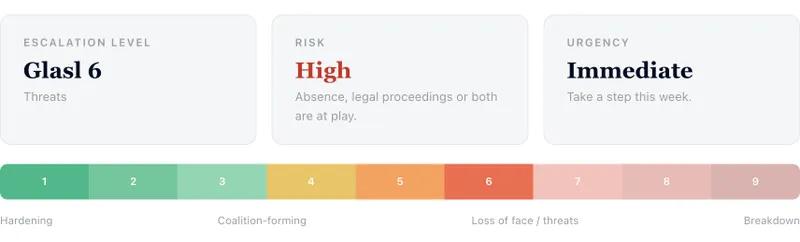
Know where you stand in 6 minutes.
The Conflict Navigator gauges how far a conflict has escalated, how urgent it is and which step fits best right now. For workplace conflicts in the broadest sense: between colleagues, within a team, with a manager, and also in a corporate context between shareholders, directors or on the works council. Completely anonymous, built on hundreds of cases we've handled.
Take the check
23 short questions about the situation, the degree of escalation and the direction you're leaning. Then, straight away, a well-founded picture on your screen.
6 minutes · completely anonymous · no account needed
With a conflict at work, the hardest question is often the first one: just how bad is it, really? React too lightly and it keeps simmering while the damage mounts — from absenteeism and staff leaving to a working relationship that grinds to a halt. React too heavily and you set in motion a process that only blows the matter up.
That's an assessment you can rarely make objectively when you're in the thick of it. The Conflict Navigator does it for you, based on the same signals an experienced mediator looks at: the degree of escalation, how communication is flowing, and signs such as absenteeism or legal steps. So you know where you stand before you make a choice.
Not generic tips, but a report tailored to your answers. Six parts.
Where the situation sits on the Glasl scale, 1 to 9, and what that stage means.
How serious the risk is and the timeframe within which you need to act.
What's going on, in plain language, built up from the trigger, the signals and the legal position.
Which step fits now and who is best placed to take it: HR, a manager or a third party.
The best-fitting directions from the Result ADR resolution compass, from conversation facilitation to mediation or a team-based approach, each with its strengths and points to watch.
Intake questions, four anchors for the conversation and what you're better off not doing.
For tension between employees, within a team or with a manager. When you want to know whether it's something you can resolve yourselves or whether you need to bring in help.
For business conflicts at the top, between shareholders or within a works council or committee.
Occupational health services and absence professionals who want to size up a case quickly and refer it on to the right place.
The questions HR professionals and managers ask us most often.
A disagreement is about the substance: you take a different view on an approach, a task or a decision. It becomes a conflict the moment the relationship itself starts to play up — think of mistrust, avoidance, people calling in sick after a meeting, or conversations that keep grinding to a halt over the same person.
The Conflict Navigator helps you draw that distinction. You answer 23 short questions and get back which stage the situation is at and what fits that stage.
Put your situation to us in a no-obligation exploratory conversation.
We'll think through the best next step with you, with no commitment.
of our cases
succeed
weeks average
turnaround time
average rating from
the parties involved